
NURture deSirE. Deepen Intimacy.
Earth’s best source for information about Adult Nursing Relationships:
ANR/ABF Intimacy, Biology, and Connection Beyond Taboo
A comprehensive resource on ANR/ABF, dry nursing, induced lactation, and the science of nurturing desire in long-term partnerships.
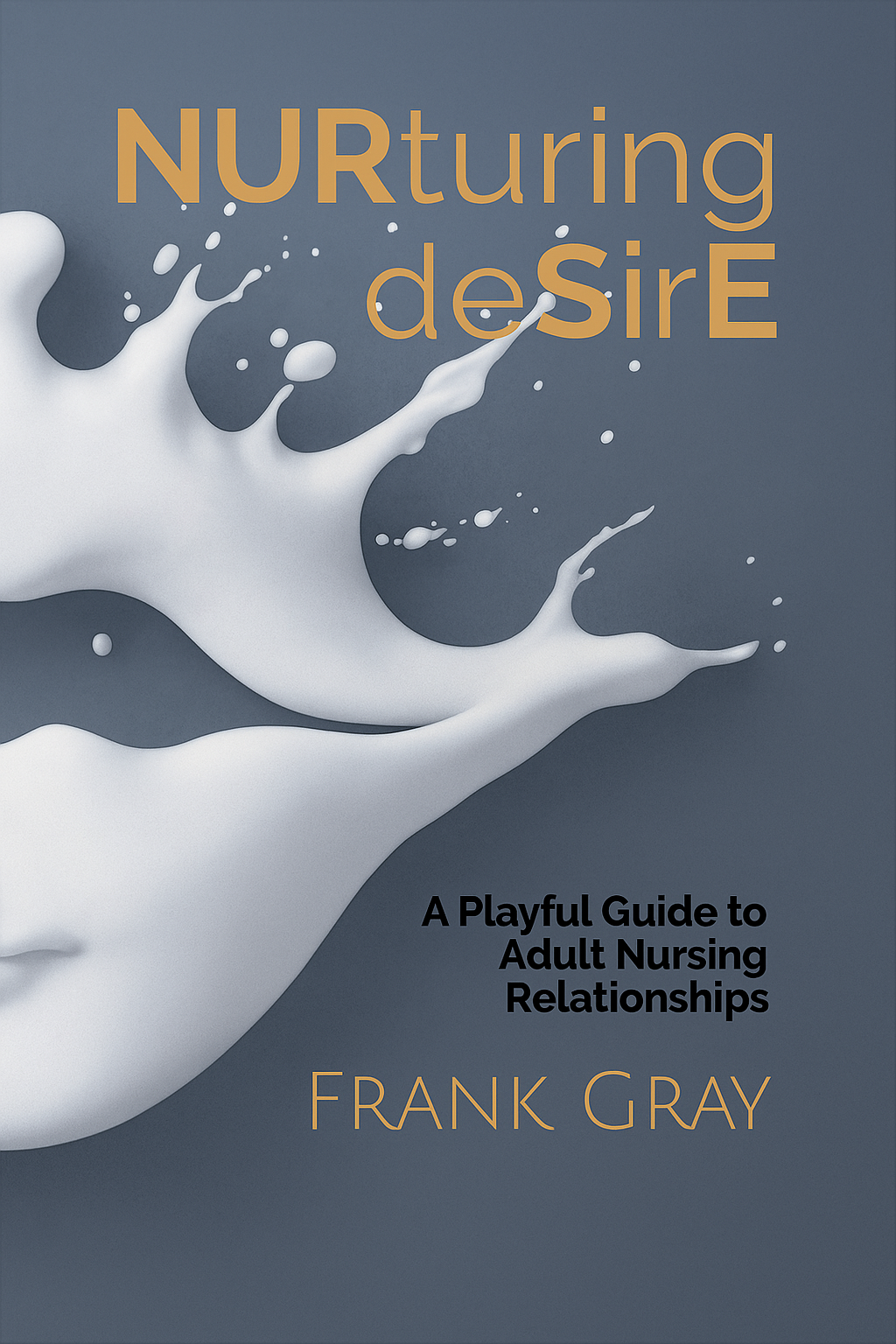

About the Book
“Nurturing Desire” invites readers into a tender, courageous exploration of intimacy — one that honors the human need for closeness, nourishment, and authentic connection. At its heart, this is not merely a book about adult nursing relationships (ANR); it is a compassionate roadmap for rediscovering trust, sensual communication, and the sacred space where two people learn to feed and be fed — emotionally, physically, and spiritually.
Written with grace and candor, Nurturing Desire demystifies a topic that is often misunderstood or hidden in shame. Frank Gray approaches adult nursing not as a fetish or novelty but as a natural, instinctive form of human bonding — one that transcends cultural taboos to reveal the beauty of care, comfort, and vulnerability between partners. Through candid storytelling, grounded psychology, and practical guidance, Gray offers couples an invitation to explore new forms of tenderness and erotic intelligence in their relationships.
The book opens with an honest conversation about the roots of desire — how modern life has conditioned us to separate love from nurture and sexuality from gentleness. It then guides readers through the emotional foundations of ANR: trust, patience, communication, and mutual consent. Each chapter builds toward integration, weaving together personal reflection, partner dialogue prompts, and exercises designed to deepen both physical and emotional connection.
Readers will learn how to approach the topic with a partner in a way that fosters curiosity instead of fear, how to build the rhythm and boundaries of a nursing relationship, and how to navigate the subtle transformation it can bring to both partners’ sense of identity and intimacy. The tone is gentle, never clinical — a companion for those who crave closeness, who sense that there is more to give and receive in love than what modern intimacy often allows.
Nurturing Desire also celebrates the body as a living symbol of trust and renewal. In exploring the physiology of lactation, touch, and oxytocin’s role in emotional bonding, the book brings science and soul into harmony. It affirms that nurturing and desire are not opposites but two expressions of the same life force — the impulse to connect, to comfort, and to create.
More than a manual, Nurturing Desire is an act of reclamation. It reminds us that every human being deserves to experience intimacy without shame and to express love through the primal, healing language of the body. Whether you are curious, already practicing, or simply seeking a more connected partnership, this book offers both knowledge and reassurance — that what draws you to nurture and be nurtured is nothing less than your most human, most sacred desire.
What Are Adult Nursing Relationships?
Adult nursing relationships (ANR) are intimate practices where partners engage in breastfeeding—with or without lactation—as a form of bonding, nervous system regulation, and embodied connection. Sometimes called adult breastfeeding, ANR encompasses both wet nursing (with milk production) and dry nursing (without lactation), unified by the act of suckling and the neurochemical intimacy it creates.
ANR works through oxytocin, the same bonding hormone released during infant nursing. When one partner latches and suckles, both bodies respond: stress hormones drop, trust deepens, and the nervous system downregulates into a state of safety and connection. This is biology, not metaphor—the same mechanisms that bond parent and child can sustain and deepen partnership between adults.
These relationships exist across relationship structures: heterosexual and queer couples, married and unmarried partnerships, monogamous and consensually non-monogamous configurations. What they share is a commitment to nurture that our culture has largely forgotten how to name.
What ANR Is Not (And What It Actually Is)
This is not fetish content. While ANR involves bodies and intimacy, it's a relational practice rooted in attachment science, lactation biology, and nervous system co-regulation. The people who practice it are seeking connection, not performance.
This is not about infantilization. Adult nursing relationships involve two consenting adults engaging in mutual care. The dynamics are reciprocal, the consent is ongoing, and the practice is grounded in mature partnership—not regression or role-play.
This is not exclusive to cisgender heterosexual couples. ANR exists across genders, orientations, and relationship structures. Bodies are more flexible than we've been taught, and milk production can be induced in people of various genders and anatomies.
This is not rare. ANR is more common than most people realize—it's simply that shame, stigma, and cultural silence have kept practitioners isolated. You are not alone in this curiosity or practice.
Yes, this includes dry nursing. Many ANR practitioners never produce milk. Dry nursing—nursing without lactation—offers the same oxytocin release, bonding, and nervous system benefits as wet nursing. You don't need milk for this to work.
The science behind adult nursing relationships spans neurobiology, endocrinology, lactation physiology, and attachment theory. Here's what research tells us:
Oxytocin creates the bond. When one partner latches and suckles, the nursing partner's body releases oxytocin—often called the "love hormone" or "bonding hormone." This neurochemical reduces cortisol (the stress hormone), lowers blood pressure, and creates feelings of safety, trust, and connection. The receiving partner also experiences oxytocin release through touch and proximity, creating a bidirectional loop of regulation.
Human milk oligosaccharides (HMOs) matter beyond infancy. Breastmilk contains complex sugars that feed beneficial gut bacteria rather than the nursing person. Emerging research, including the RAMP trial, suggests these prebiotics may improve cognitive function, reduce inflammation, and support healthy aging—even in adults.
The nervous system co-regulates through touch. Adult nursing leverages the polyvagal system—the part of our nervous system that governs safety, connection, and rest. Physical touch, especially rhythmic and sustained touch like nursing, shifts both partners out of fight-or-flight and into ventral vagal tone: the physiological state where intimacy, digestion, healing, and bonding become possible.
Lactation is more flexible than we've been taught. While typically associated with postpartum mothers, milk production can be induced in many bodies—including those that haven't given birth, cisgender men under specific hormonal conditions, and people on various hormone therapies. The biology of lactation is adaptive, responsive, and far less binary than cultural narratives suggest.
Featured Science Articles
The Biology of Milk-Based Intimacy
Milk Drops (a NURturing deSirE Blog):
Investigations Into Intimacy, Milk, and Meaning
Featured Essays:
These essays examine adult nursing relationships from every angle—biological, cultural, practical, and philosophical. They're written for people who want to understand intimacy more deeply, not just practice it differently.
Adult Nursing Relationships (ANR)
Dry Nursing & Non-Lactational Intimacy
Biology, Psychology, Culture
Long-Term Partnership & Nurture
Embodied Desire & Nervous System Regulation
Frank Gray is a writer, craftsman, and lifelong explorer of the subtle interplay between love, trust, and human connection. With a voice both grounded and lyrical, he invites readers to rediscover intimacy as a living art form—something to be cultivated through patience, curiosity, and deep respect for the body’s wisdom.
Drawing from decades of observation and personal experience, Frank’s work bridges the emotional and the sensual, the intellectual and the instinctive. His writing gently dismantles cultural barriers around nurture, touch, and desire, revealing how these universal forces can heal and transform relationships.
Outside his writing, Frank is a maker by nature—a metal sculptor, gardener, and musician who sees creativity as a spiritual practice. He lives in the Pacific Northwest with his wife of three decades where the quiet rhythm of the countryside informs much of his reflective tone.
Nurturing Desire is his first book, a work that speaks to the courage it takes to love with both tenderness and honesty. Through it, Frank offers not only insight but also permission—to feel deeply, to connect freely, and to embrace the nurturing essence that exists within us all.

About the Author
Frequently Asked Questions About Adult Nursing Relationships
What is an adult nursing relationship (ANR)?
An adult nursing relationship (ANR) is an intimate practice where one partner nurses at the other's breast, with or without lactation. ANR focuses on emotional connection, comfort, nervous system regulation, and trust—tapping into biological needs for closeness and nurturing between consenting adult partners across all relationship types.
Is adult nursing sexual or intimate?
Adult nursing can be both, either, or neither—it depends on the couple and the moment. For many, ANR is primarily about emotional bonding and comfort, similar to extended cuddling. For others, it blends sensuality with intimacy. Partners define what it means for their relationship without following external scripts or expectations.
Do you need milk for adult nursing?
No. Dry nursing (without milk production) is just as fulfilling as wet nursing (with lactation). Emotional connection, skin-to-skin contact, oxytocin release, and nervous system regulation happen with or without milk. Many couples prefer dry nursing because it's spontaneous, requires no maintenance, and focuses purely on connection rather than production.
Is adult nursing safe?
Adult nursing is safe for most healthy adults who communicate openly about health and boundaries. Avoid nursing if either partner has transmissible infections (oral herpes, strep throat, etc.). If inducing lactation with medications, consult healthcare providers. The practice itself carries minimal physical risk when practiced with consent, hygiene, and open communication.
How do I start an adult nursing relationship?
Start with honest conversation: share why ANR interests you and frame it as wanting deeper connection, not performing a role. Create ritual (warm space, dim lights, music), begin with touch and holding before latching, expect awkwardness initially, and communicate throughout. Read comprehensive guidance in NURturing deSirE for detailed protocols, positions, and practices.
Is adult nursing normal?
Yes. Adult nursing is more common than most people realize—it's simply not discussed publicly. The practice is biologically grounded (oxytocin, touch, bonding), historically documented across cultures, and practiced by couples worldwide. If it brings you and your partner comfort, connection, and mutual consent, it's perfectly normal for your relationship.